
by TWY
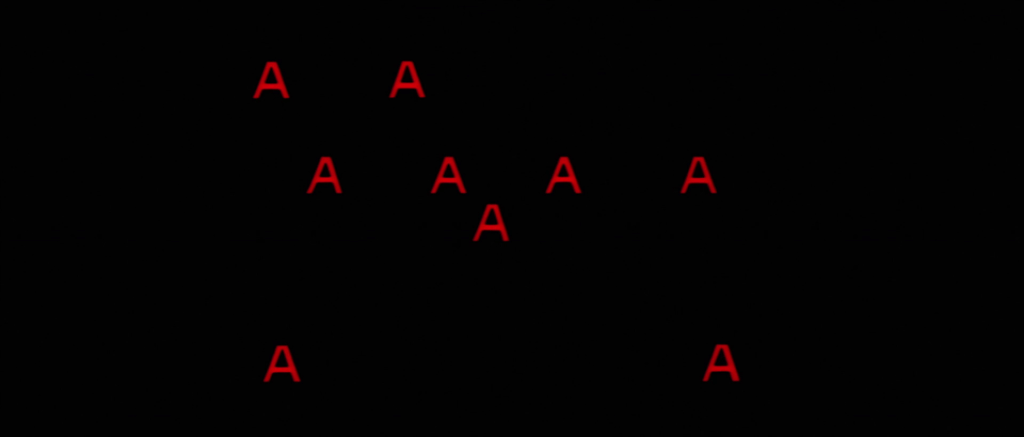
I had seen Pierrot le fou, yet I have not; the images and sounds were always there: the color, the disjointed montage, the duo of actors, Belmondo’s line reading, Anna Karina’s close-up, the breaking of the fourth wall, Samuel Fuller’s quote, the musical numbers, the final explosion…… They have always been there, yet one doesn’t start to see until one let them flow free, like the firework on display that bookended an reunion of old lovers. This time, one really starts to see, to hear, from A to Z, like the opening titles that reveals itself in time. Godard had shown you how to watch a film. His film is the rarest as in it demands not only multiple viewings, but “parallel” viewings. On first viewing, one only got the “A”s, but it mustn’t stop there, the secret hasn’t been revealed. It’s so easy to miss the carefully squeezed bits of character details upon that first viewing, or even, the second “first” viewing, as we are overwhelmed by the fragmented presentation of the opening minutes: verbal expositions which characters obligatorily put out are drowned in the darkness from the very beginning: Who is Ferdinand? Who is Marianne Renoir? What’s with Marianne’s gunrunning brother, Fred? We barely remember this one’s face. Not that we are not careful, but it was because Godard was so determined and poetic, that such details are deemed insignificant, at least at this point. No psychology. Ferdinand, an ex-TV personnel who was just fired; Marianne Renoir, who temporarily babysits his daughter…… Sure, by return to their respective scenes we can get those information, but how is it important when the film had already blossomed in all directions, as Jean-Pierre Gorin had said in his brilliant essay, Godard is a boxer who strikes from every unexpected corners.
Like music, Pierrot le fou tells you more just by Belmondo’s melodic delivery of his lover’s name: “Marianne… Renoir.” There it is, here we see the ultimate lyricism, and the undercurrent which the name, partly inherited from Auguste Renoir, the French painter whose portraiture Godard proudly presented in many occasions, implies. This is indeed a portrait, and all the better, a portrait where the subjects return the gaze to the viewer. Indeed, there is not only Ferdinand, but also Pierrot, the crazy one, which implies, more than anything Godard had done prior to this film, the physicality of the actor and of the film. Belmondo, himself a renowned action hero of the French cinema, understands this, who in the Technicolor, CinemaScope glory, jumps up and down and plays tricks and routine with limitless energy, or even, he plays with the frame; and there is nothing more of that bittersweet taste, of the scene where Anna Karina, who had never stopped being animated in Godard’s cinema, walks around the shore yelling “What can I do? I don’t know what to do.” Even that, one must move to live. At 1965, Godard’s work had ventured into an evermore intellectually sophisticated state, and the physicality amplifies that, though the flowing of action, either blossoms through the actors, or with the montage: unstable, dangerous, explosive.
The physicality moves the ideas forward. It is the greatest virtue of any films, a film that mutates and rethink itself with each passing sequence: genres are being examined, tested, mixed, different forms of expression shattered, “it was an adventure film, it was a love story,” a domestic drama, a comedy, a musical, an essay film, a commentary, a gangster film, a love story, a film noir…… In Marianne Renoir’s unfurnished room in Paris, white wall dominates the wide frame (just as Rivette would say about Rossellini’s Journey to Italy, cinema’s first modern work), and then things starts to fill up the negative space: painting, guns, a dead body, words on the wall, images, colors, sounds, music…… Suddenly, a marine ship appears in the back of the frame. It would be funny to consider the statement of Samuel Fuller, the words of “love, hate, action, violence, death —— in one word, emotion,” as the guiding principal of the film which Godard would carry when embarking on the journey, for the scene was filmed in the last days of shooting, where Fuller improvised this now-iconic line, so it might as will be a reaffirmation of that truth. As the journey progresses, the film becomes more outrageous, sketchy, furious, incomplete, decentralized, depressing, repetitive, and finally, alive in the fiery of a glorious death: our protagonist’ face, painted blue, buried in one yellow rounds of dynamite, which then infused by a round of red, “parallel” layer of explosives. Godard believes in bombs, and one must light it up. Beethoven’s Sonata No.9 graces the end credit, light as a feather, the joy of filmmaking that is, despite all odds, we are still here.


为 重返《狂人皮埃罗》 – TWYcinema. 发表评论 取消回复