
by TWY
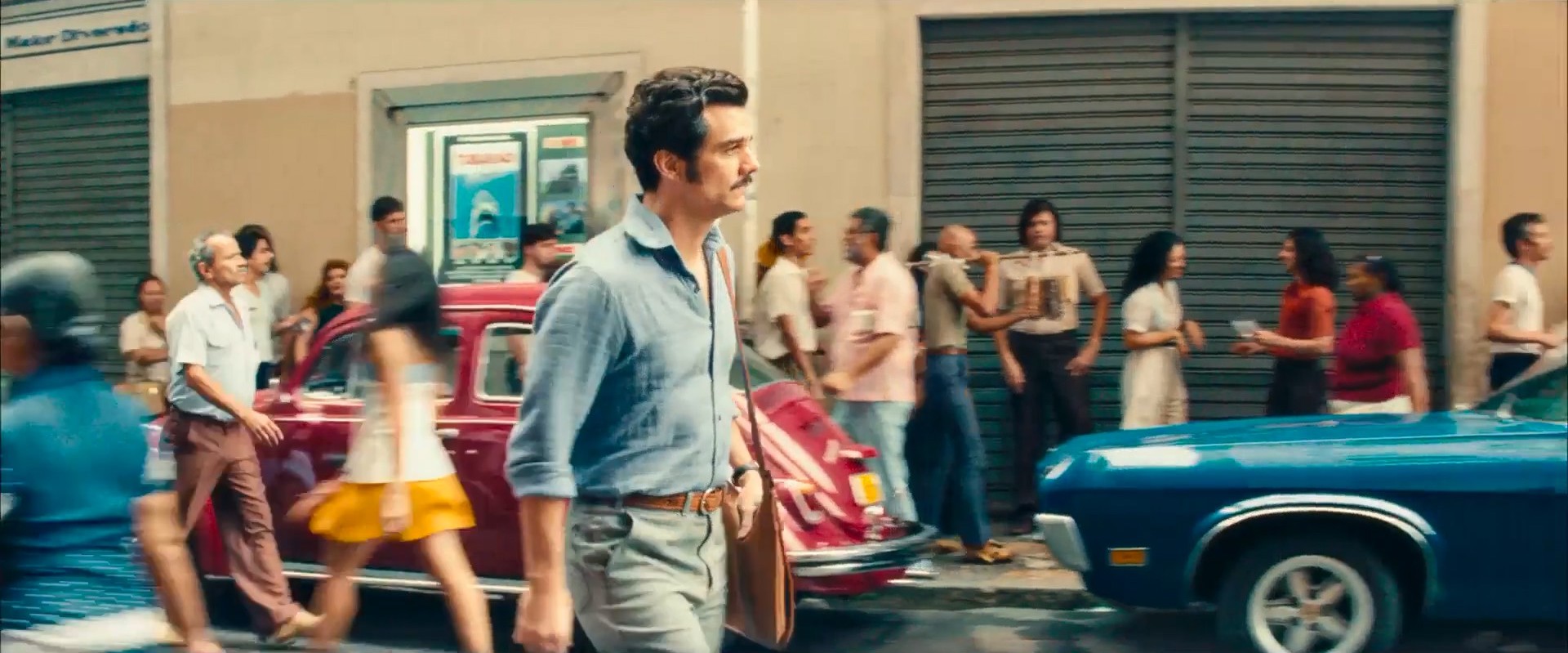
Strictly speaking, O Agente Secreto is not a spy thriller. If this is Kleber Mendonça Filho’s most exciting film yet, it’s because this cinephile-turned-filmmaker has fully utilized his experience as a spectator to create a complete dramaturgy: a way to stage the world. It is not a spy thriller, but something that retains its materiality and memory. Unlike the more direct, though incomplete, appropriation of genre seen in Bacurau (2019, co-directed by Juliano Dornelles), this new work follows a rhythmic, figural progression of genre sensitivities. Here, Mendonça Filho transforms his beloved hometown of Recife into a collage of 1970s textures, music, and personalities. It doesn’t matter whether Wagner Moura’s Marcelo is “a secret agent” in the narrative sense, it’s enough that the camera films him as one. Let us not forget Hitchcock, who directed the mother of all modern spy films with a nothing-plot of mistaken identity.
But the hero of O Agente Secreto was indeed pursued by a force, the specter of military dictatorship if you like, and to make a spy film seemed the only choice here in term of staging the action, to intensify the experience of living in hysteria, by dramatize every move of the body, from driving at night, making a call from a payphone, to visiting a secret group of friends…… If the filmmaker encourages us to bring our memories of cinema here, it is because “hysteria,” wrote Serge Daney, “doesn’t go without the spectator’s position,” and “fiction is the power structure.” In North by Northwest (1959), Cary Grant must willingly assume the identity of a non-existent person, whose name was accidentally imposed on him by the system of espionage. Here, in Recife, fiction and reality also intersect, and duality haunts every front of life. The three chapter marks of the film already maps out its project: to identify a nightmare, and to transfuse a singular experience as history. Therefore, the film plays out almost like a little boy remembering his father, always missing from his life, as this larger-than-life existence, a character from the movies.
The first tactic of Mendonça Filho: to let unknown bodies run wild, proliferate. There are strange characters everywhere, unavoidable, vivid portraits played with force by an ensemble cast. The carnival setting is therefore a chance to bring characters together, both the named and the nameless. As in O Som ao Redor (2012) but with a larger canvas, we will not be safe from a sudden cut to the neighbors (some very far away), to be stranded there, then to return knowing that the world is a larger network. This idea of neighborhood, now unbounded with physical space of his previous work, extends to wherever the next shot will reveal. The film’s slow and thinly threaded story only contrasts the rapidness in the succession of shots, as we are introduced to new faces at a dazzling pace.
Secondly, the abstract narrative form itself mutates as concrete figures, which at first glance suspends its meaning. Each new image opens a space and rolls a dice. Arriving at his temporary home at Recife, a strange creature appears to surprise Marcelo and the audience: a double-headed house cat that must be seen to believe. This bicephalic creature looks completely ordinary in wide shots, its secret only revealed once we look closer. Special effects? A nod to Cronenberg’s Dead Ringers or Japanese tokusatsu films? Brazilians have long been flirting with horror cinema. With an effortless joy, the film imagines the mutation of its form within itself, turning itself into rough sketches of little monsters. Horror film references will soon intensify. If the cat provokes us first by its literal strangeness, imagination would arrive later: the theme of double quickly propagates, from split diopter shots to split screens. Curious: How does a cat with three eyes see the world? Of course, cinema once had a machine with three eyes: the Cinerama system, which uses three separate projectors for a large anamorphic image, a format Mendonça Filho knows well. The widescreen here is a remarkable canvas: a world that reveals itself from the edge of the screen, omnipresent with blank spaces or dark spots to be imagined, invaded, seized. Loose ends are everywhere, forming a hidden network that bleeds into the narrative. There are always two threads in the running, always in communication by connecting shots, yet remain severed in reality, between birth names and aliases, images and ghost of images.
Within the film’s gallery of characters, a recurring motif quickly surfaces in the form of fathers and sons. From the two hired assassins to Marcelo’s past academic rival, this motif of “Father and Son”, biological or not, is consistent from one story thread to another, as if a certainty of mankind. As presence and iconography, these characters suggest a mysterious alignment within the narrative, setting up figures that fill the widescreen image. Recall Jean-Claude Biette’s writing on the motif of “two brothers” in Jacques Tourneur’s Wichita (1955), “this is not just the script’s craftiness, but a fundamental theme of the film’s mise en scène”, the theme is a figural mechanism to conjure new relations between bodies and experiences. Everywhere Marcelo goes, from his past to future, he keeps encountering these mirror images, leading towards the awesome vertigo of the final sequence. A final transfusion: the more we see this duo of hitmen, the less we see the hero and his son together. Finally, the theme is imposed on the actor himself: the grownup version of Marcelo’s son will also be played by Moura, who seems to have forgot his past live.
As it turns out, to complete this odyssey in search of historical evidence and historical fiction, a filmmaker would also make two movies. As Marcelo enter the São Luiz cinema, located at the heart of Recife’s downtown, fans of the filmmaker will immediately recognize it as the famous movie palace from Retratos Fantasmas (2023), Mendonça Filho’s essay film—an archive of his family history in Recife, his cinephilia, and the key locations that would later inform O Agente Secreto. Retratos also follows Mendonça Filho’s trajectory as a filmmaker, whose first films are made in his own family apartment (O Som ao Redor and Aquarius (2016)). But now, his gaze extends towards the larger city itself. The essay film becomes a hidden skeleton key, an archive left for future viewers. The lovingly Mr. Alexandre (Carlos Francisco), father of Marcelo’s late wife and the projectionist at the São Luiz cinema in the fiction, was clearly inspired by a Mr. Alexandre Moura, projectionist at the Art Palácio cinema. During his formative years, before that movie palace closed business, Mendonça Filho had filmed this Mr. Alexandre in great detail, forming a beautiful friendship. As we see the videotape footage of the filmmaker traveling through the cinema’s emptied stairways and corridors, filming it as if through the Overlook Hotel, how can we not dream it as a site for secret rendezvous? If O Agente Secreto conjures familiar sensations of from thrillers of the past, despite never embody the genre, it’s because the filmmaker also reckons with his own past images: this personal memory must first be seen as fiction. As we revisit the footage of Mr. Alexandre, it’s clear he was already larger than life—already a movie character.
Since his cinema is strictly spatial, from Retratos to Agente, each time we exit a prolonged scene, always exhausting itself before the next, it is as if we, the audience, have already left the theater. We are standing in front of the cinema, facing the city street, but the quality of streetlight has changed, heightened; the movement of passing pedestrians becomes dramatic, and our eyes begin formulating visions as shots, and our bodies as a camera; finally, we must take a tentative look at the audience surrounding us, freshly emerging from this collective experience. There is a persisting sense of paranoia and fear, but always mixed with a fascination that the films also form our reality. In Mendonça Filho’s films, we will exit and reenter these theaters again and again, each time with a passion for narrative and momentum, with different dangers of the world. In fact, we are entering another theater immediately after leaving the previous one. In one sequence, Marcelo exits the São Luiz and immediately finds himself swept up in a carnival crowd. We might even switch roles—suddenly caught in the fate of a random stranger on a busy street, having just seen what he has seen. The film’s final Hitchcockian twist redirects our empathy, revealing the only path to understand history: more than one is seeing.

留下评论