
I contributed this article to Issue 110 of Senses of Cinema, with thanks to Hamed Sarrafi, the guest editor of the dossier on El Pampero Cine. I post here the introduction of the article with a link to the full article below.
by TWY
I. Introduction
Like how Julio Cortázar wrote about Charlie Parker, here is an attempt to write about something by means of something else. In the short story “The Pursuer” (“El perseguidor”), narrating as a jazz critic, Cortázar stages a fanatic conversation between himself and the great alto saxophonist, as if splitting into two minds who each must speak in his own language. Can writing speak of music? In front of a great figure, fictionalised as Johnny Carter, the French-Argentine novelist does not pretend to write “about” music. Instead, he writes about the musician’s obsession with time, of him wandering the empire of memory in his head with extended monologues, much like Parker’s improvisations, passionate and often under the influence: “… and Johnny was hitting himself in the forehead and repeating, ‘I already played this tomorrow, it’s horrible, Miles, I already played this tomorrow’…” At the end of the novella, Bruno, the narrator who has penned a biography for the musician, begins to question whether his literary theorisations have served justice for his best friend, who performs music in such a way even he cannot comprehend himself. Cortázar’s work, thus, becomes a duel between a writer and someone invisible, silent.
To arrive at a conception of a musician and his work, a novelist must traverse through his own realm of fiction, where writings and (unseen) images become landscapes of time. The eulogy of a musician thus also describes the works of Marcel Proust, Jorge Luis Borges, or Cortázar himself. But if the work of El Pampero Cine resists anything, that would be this figure of the tortuous genius, with only their arts to make them eternal. And yet, from these films, we also face this terrifying immortality – a text that communicates with all arts, all the mummies of our history and nature. With time being our motif, what this text proposes are certain dialogues between the many musical voices accompanying the work of El Pampero, now standing at some two dozen feature films since 2002. If music strengthens the presence of El Pampero’s work, it is because of how its history and traditions situate us in a place, from the memories conjured by genres to the physical space of making a film.
We begin with some pragmatic notes. As Johnny Carter would have suggested, music is something we can use to experience the world in time, and that is to say, to experience the idea of our past, present, and future. In Trenque Lauquen (Laura Citarella, 2022), we can recall the music that accompanied the two amateur detectives’ travels, both looking for a disappeared woman they loved: a man (Ezequiel Pierri) listens to his stereo while driving down an open road, and he hears a song titled “Los caminos” (“The Roads”, composed and performed by Miro y su Fabulosa & Orquesta de Juguete), which words describe a past friendship. He drives wordlessly, in serenity, who simply listens, taking in this landscape where he continues his search. We listen to the entire song in a continuous shot, where the camera looks at the landscape, then pans to look at the man, and then back again. After the song finishes, he replays it.
What does it mean to play a song again? Is the song a question or an answer to his travels? Perhaps not important, other than the fact that this is a song he carries. Or rather, it is the filmmakers who carry the songs around. Likewise, to discover Citarella’s previous film, Las Poetas visitan a Juana Bignozzi (co-directed with Mercedes Halfon, 2019), is also to discover an almost imperceivable yet mysterious cue, composed by Gabriel Chwojnik, El Pampero’s trusted composer, with the sound of a theremin. This airy instrument, performed without touching the device itself, was popular in soundtracks of science fiction films since the 1950s and paved the road for electronic music while its inventor, Leon Theremin, became a legendary figure, who led a double-life, working undercover for the Soviet Union, having developed a prototype of television but afterward seized as an asset for espionage. (How the theme of spies exists in El Pampero’s world is entirely another story – no less fascinating.) Now, back to Citarella’s films, this short, ghostly melody, later heard again as part of the theme for Trenque Lauquen, was thus transformed as a totem, reminding us how the two films were conceived in tandem, as their proximity in motifs and concerns. The sound of theremin becomes a wave of thought, the rumbling of a filmmaker who, while making one film, dreams another: stories of detectives being given a library from another person’s life, who must get lost in time and disappear into their cobwebs of mysteries.
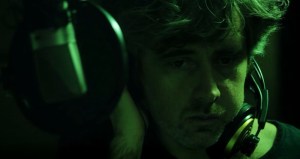
II. Inventions on the Motif in La Flor
A man records a song in a studio filled with greenish lights. “Yo Soy el Fuego” (“I am the Fire”) is the title, with a rather catchy melody in the style of Pimpinela, the Argentine brother-sister duo with their signature style of alternating dialogues, centring on the arguments of a couple. “Yo Soy el Fuego”, in particular, seems to be a more wrathful version of the duet’s 2002 hit “A Esa” (“To That”), whose lyrics boil down to a melodrama of a woman pleading to her former man, who has left her for another woman. Episode Two of La Flor (Mariano Llinás, 2018) centres also a couple – a duo of pop singers, who have loved and hated throughout their careers, and it is also a film about a song being played repeatedly until its breaking point, passing through different voices, genres and time.
For Mariano Llinás, to open a film is to bring forth a certain tension, a shot/reverse-shot between a landscape and the fiction that descends upon it. A landscape by itself, be it a face or the earth, refuses generalised readings, but beneath this image lies a history of cinema of the invisible. As in the “landscape films” by John Ford, James Benning, or Huillet-Straub, a plain serves not only as an open ground for civilization but also as a hiding place for stories, secrets, and evil. These filmmakers wander between the canvas of writing and the writing itself, one is seen while the other is not, only “acousmatic,” to use the term from Michel Chion, “sound one hears without seeing its source.” Look no further than the first sequence of Historias extraordinarias (Extraordinary Stories, 2008): a typical murder mystery scenario unfolds, seen from afar by a seemingly objective camera, which desires nothing but to take in the landscape and the horizon, with an omniscient narrator that also fracturing the narrative temporality: what was described as a nocturnal rendezvous was shot and seen in broad daylight. But after this, we are introduced to the film’s first song. Composed in the style of a cumbia, a type of Colombian dance music, this theme bombarded as the film’s opening credits made its frenzy entrance, almost too joyful, too “cartoonish,” as Chwojnik described. An unexpected sense of rejoice extinguishes the danger suspending from the previous shot – a primal melody, submerging itself in pure rhythmic pleasure, too pronounced to our ears and eyes.

留下评论