
Translation note: This text was written on the occasion of the theatrical release of Memoria in mainland China. This rare event marked the first nationwide release of a feature film by Apichatpong Weerasethakul.
by TWY
For our theaters, Memoria is an anomaly, an alien. Its unexpected arrival casts a spell upon the cinema spaces, only a precious few, as if no films have ever been screened or heard there. It’s box office success, some modest 2.5 millions RMB (around 360,000 USD), but still considerable, confirms a secretive movement of the moviegoers, ranging from local collectives, cine-clubs, to individuals that sparks a greater flame. But even for those already accustomed to the work of Apichatpong Weerasethakul, the film remains a strange object. Naturally, one should not expect the same nature and worldly signs, now that the Thai filmmaker works on another continent, he also hides away the gods and spirits that once inhabit his films. For now, the filmmaker is searching for more secretive things, things more likely hidden in their every day appearances—the first evidence: he’s searching through our 21st century.
Memoria is a film inhabited by machines. Whether contemporary or ancient, from a sound mixing suite to a stone, from the city of Bogotá to a CG-generated spaceship, the film exhibits these machines while reconfigures their meanings. The first hour is almost a travelogue, a voyage around scattered corners of a great library, with sections on acoustics, botany, archaeology, etc. We immerse ourselves in spaces of different fields and arts, each attempting to put together an image of the world. These distanced fields intersect through Jessica’s path, and through their share worth of materials, which the filmmaker gather, for he only films things that last in time, whether a picture of an orchid or a 6,000-year-old skull, with their origin impossible to trace. Among those, Jessica, played by Tilda Swinton, is the most essential “machine” of the film, with memories implanted from someone else, almost a replicant from a Philip K. Dick novel. This stranger from another town, with her ill-timed stiffness of a European Hollywood star, searches with us many things: a sound, a piece of memory, personal, historical, or celestial.
The premise for this kind of creation is that it has to be wholly contemporary, even so that it must begin in a city, even though it expects a return to nature and wonders. If Apichatpong wasn’t content with his audience’s anticipation for natural or supernatural spectacle, it’s because, for the filmmaker, one must first experience the city completely, to live, to walk, so that one understands its being as an artificial “nature,” a part of the essence of modern life. And only then are we qualified to approach nature and to seek from its infinite history. Apichatpong walks this town with a firm lightness because, for him, the city and nature don’t simply form binaries since the machines surrounding us, like living beings, also share the world’s consciousness. This thinking process also leads us closer to cinema itself. Memoria proposes to us a rather peculiar question: Does this machine of cinema (or Swinton) also think about the devices it films?
A loud “bang” is heard by Jessica, who enters the frame, as just us entered the film. But this sound is sourceless, not recorded at filming, but synthetic, manufactured. The sound is not captured with cinema, but instead was “served” to us by cinema, from a simple montage: a sound + the woman who heard it. A Godardian question: how does a sound and an image come together while being “distanced and just”? If the loud bang heard by the filmmaker himself, the Exploding Head Syndrome, was clinical, then the one heard by us and Swinton requires a diagnosis based on evidences that are purely cinematographic, that is, to seek out where the sound, as an entity, originated. Attempting to answer this illness, Apichatpong chose the only way he could, that is to pose the question as the film itself, not just to a concept of the art of cinema, but rather to the very instruments that made cinema: the camera, the sound mixing suite, the editing table, etc. As a result, Apichatpong creates a sound and the need to recreate it, an unknown to be traced back to its source since all our human creations are part of the legacy of our history and memory.
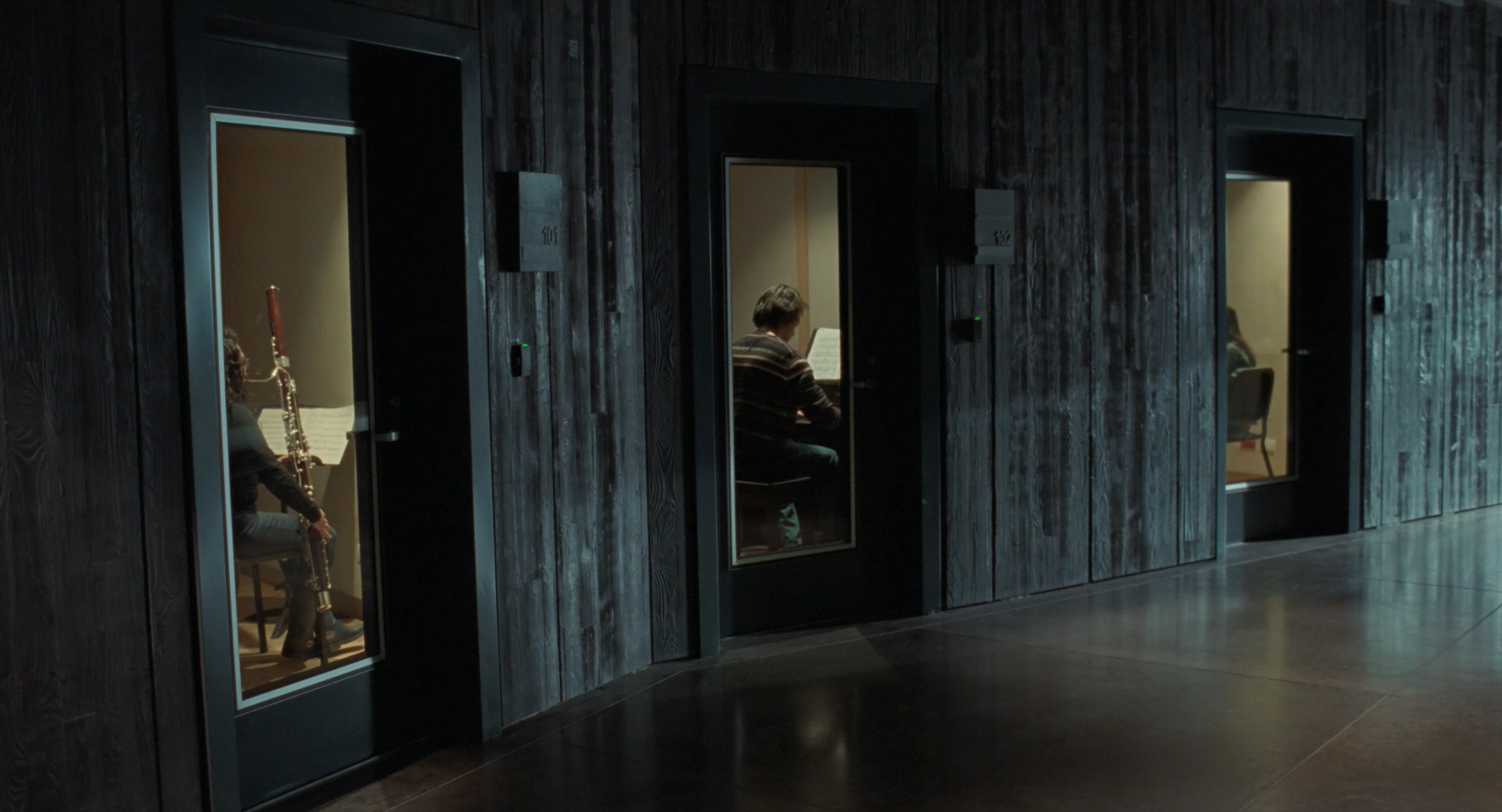
If the machines created by humans from each generation contain all the complications in history that led to their creations, then allow us not to proceed lightly. In the opening of the film, the roaring of cars may already contain the totality of human progress and terror of the 20th century; likewise, the rapport between a musician and their instrument holds the entire history of their musical practice, from each rehearsal to each performance; and thus, what kind of history does the mixing suite had contained, along with the young Hernán (Juan Pablo Urrego) who operated it, allowed it to help us conjuring memories?
Today, while we are reckoning the potential danger of AI, particularly the rapidly evolving generative models of images and words, we are also maintaining “hopes,” a certain hope that we can also find in such technology genuine consciousness, even artistic visions beyond algorithms. But if those machines haven’t yet possessed such intellect or consciousness, and their abilities remain bonded by their crude assembly of information or artworks already in existence, it only proves that we, the human generation that led to its creation, have also failed our consciousness, replaced by a rule of information. Such is a system that only distributes, it doesn’t create, which today results in our technocratic melancholy, for human beings would be the ones responsible for creating this rule in the first place, from the Internet’s bottomless pit of garbage imagery (now among with everything else is ruled under the umbrella word “content”), to reducing artistic creation towards an arithmetic subtraction from arts of predecessors, seen from pitching strategies to film reference libraries like ShotDeck, only that the machine has accelerated this rule even more. Therefore, the technologies we have brought to life have naturally become our true successors. This machine computes without senses, eyes, or ears, burning through information just as one burns through petrol or forests. Thus, all these “images” AI generates can be nothing but charred corpses.
To make this detour on AI is to say that Apichatpong is not a filmmaker intimidated by such technology because the machine made by humans today is not those from an artist’s dream. When a filmmaker dreams up a machine, it can only be a machine yet to be created, for it will be a machine with a consciousness that can only be seen through cinema. Consider the sudden appearance of the handheld shot, in one of the more confounding sequences of the film, which introduces an instability in form, an abrupt reconfiguring of film senses, as if the handheld camera, replacing the film’s preceding stillness, is pulling the audience towards a certain realistic point of view. But this point of view thus becomes too harsh, its realism undue, as if, at the same time, the camera itself realizes it’s too easy to just follow the characters, which later morphs into the beautiful tracking shot on the street. Does a fixed shot dream of the camera moving? The meanings of these shots will remain a mystery, but we understand it through the underlying structure of mise-en-scene. Our senses also inform us that such movement, always too easy, seems to be canceling something, reminding us to see a certain void.
Regarding Cemetery of Splendour, Stéphane Delorme wrote in Cahiers du cinéma (“Il faut prendre soin de nous“, No. 712, June 2015) that the film is “playing” its audience as its instrument, citing Jean-Louis Schefer. And when it comes to Memoria, as we understand this symbiosis between machines and humans, this idea of an instrument can extend further. How about imagining that the film is not only playing its audience but first with the theatrical space itself: the screen, the speakers, the wall, even the seats, and the vacant space above, as the light from the projector passes through the auditorium. The loud bang that shook Tilda Swinton first shuddered the theater itself. Later, we see Jessica and the young Hernán attempt to recreate this sound, this set of wavelengths. In the mixing room, Apichatpong filmed a simple sequence, for the space in front of us is a space for listening, with the computer searching not data but memories, despite going through the materiality of the 21st century, from its grid of switches to digitized or virtual substance. Finally, as the waveform, a sound becomes an image. As Delorme wrote, “characters in fiction require the nutriment from our imagination,” so let us make up our own hypothesis: Is a sound file on a computer real sound, or is just its data real? Where lies the true connection between humans and machines? Why can’t the film be a science-fiction novel? If we were to return to this set of traveling shots above, perhaps it is because of that formal disorder that resulted in the disappearance of the young Hernán, and not long after that, the “second” Hernán (Elkin Díaz) will perhaps trigger the next disruption: the location sound shrinks into silence, giving space to the becoming of sound-memory.
Memoria perhaps is the greatest film to have shown us, in such clarity, the very material of sound. As the camera films inside the mixing room, we not only see the work of the technician but also how this machine can possess consciousness that leads to profound discoveries, whether it came from a human being or the machine itself, and despite performing an act of informational exchange, the computer is, ultimately, looking for something that is anything but information. Just as Leos Carax did in the same year in Annette, Apichatpong had sampled, in his secret way, the earliest known recording of a human voice of the world, Au Clair de la Lune (1860), and these two modern masterpieces thus proposed a new origin of the history of cinema, both traced back to this very moment when a sound was transcribed as image of waveform, engraved on paper. In this mixing room sequence, it’s even possible to say that it’s true power lies in the fact that as the audience is watching this arranging and caressing of sound, what we truly see is the the sound mixer himself, from beyond the screen, personally toning the movie theater, as if the theater itself is a cathedral organ which sound vibrates through the entire space. Just as Pedro Costa had filmed the editing room of Danièle Huillet and Jean-Marie Straub in Where Does Your Hidden Smile Lie?, here the camera must also look directly at the work process itself. Therefore, a great film provides us with a connection to the place from which it was made, provoking bodily responses from both the mixing room and the theater. For such beings, one can only call it “a memory,” as well as this “rumble of the earth” searched by Jessica or the “hidden smile” searched by Straub and Huillet. More than just our responses, we feel the spaces’ reactions as well. If Apichatpong’s film often hypnotizes its audience, it’s worth noting that machines never sleep. The cinema, a place now constantly invaded by images of self-indulgence and advertisement, awakens from its heavy stupor, and its revived senses touch ours. Apichatpong, as well as cinema itself, had given us a sound, and by the second hour of the film, whether it is the middle-aged Hernán or Jessica herself, it has eventually became a sound, a sound that “serves” memory. If one prefers cinema over the others, it is because this is the art that serves, whether the large cinema, the small television, or elsewhere, it provides image and sound so a world is seen, as well as its component, and graces these machines with meanings through great work.
The theatrical release of Apichatpong’s film was an unprecedented event. Still, even if the experience of watching the film with an audience is already precious, we may as well imagine an empty screening of Memoria: the cinema will remained open, not unlike the one in Tsai Ming-liang’s Goodbye, Dragon Inn, Apichatpong’s favorite film. In this “depth of delusion,” we could say that the film is still being shown, although it is only played by the cinema for itself. And this loud bang, or the rain heard at the end credits, is only shown and listened to for the cinema. We must imagine that such an “empty” projection is the unknown of our world, unseen by us but remains. Whether natural or mechanical, one should know that consciousness is being created and transmitted, with some of it launched into our human mind. Nonetheless, this requires us to dream for ourselves, to listen, look, and discover.


留下评论