
by TWY
In Michelangelo Antonioni’s Blow-Up (1966), David Hemmings plays a fashion photographer, but we didn’t know that just yet. When we first saw him he had just emerged from a London flophouse. We didn’t know his name nor his history – in the wide shot, he appeared to be well blended-in with a crowd of workers. The world is in near greyscale, not quite in black and white but almost, except for bunches of colorful and euphoric youth swinging through the streets in their Jeeps. The kids are kinetic, while the camera looks at them calmly in a distance, not quite participating. The workers and the kids: two sets of crowd are being juxtaposed here, and Antonioni’s treatments of all that’s happening signals one decisive fact about our photographer: in a direct paradox to his occupation, he does not look at anything, he is, at this point, an abstract figure, even as he hopped on his Rolls-Royce convertible. The filmmaker is lucid and clam confronting this sociological symbol that isolates him from the rest of the crowds, and displays no unique sensation whatsoever, unlike the youth that rallied around him. Such juxtaposition is no coincidence, and it’s something already hinted at in the film’s opening credits. Against a field of grass we see the credits, encoded within another image: with the title “Blowup”, we also see an exotic dancer dancing for a crowd and a figure with a camera, a detail so quick that was gone in a blink of an eye. The dancer continues her movement through the rest of the credit sequence, but beneath the texts, whatever figure that was there had also been turned into obscurity. These could all be the words from an early chapter of The Stranger, where Albert Camus ingeniously put his description of the victory celebration of some soccer team side by side with, simply, that of the passing of streetcars. It’s a world full of things happening, but to the protagonist, it was simply just that and nothing else.
It’s another story in Hemmings’ fashion studio. In a sense this is where the audience first gets to know the enigmatic photographer. Here, Hemmings is playfully ecstatic, the act of the photo shoot was deliberately staged like a sex act, or in fact, an act of prostitution. We will never see the woman again, just as how she first appeared in the scene: as a reflection on the mirror. There are more women like her who come and go in the studio, as well as things, an antique fan pillar, for example, but it was never clear to us that why he bought it in the first place. What is an antique? A kind of material that only seems to be in the present but deemed functional only in history. Nobody ever “uses” an antique, except as a piece of the past for display.
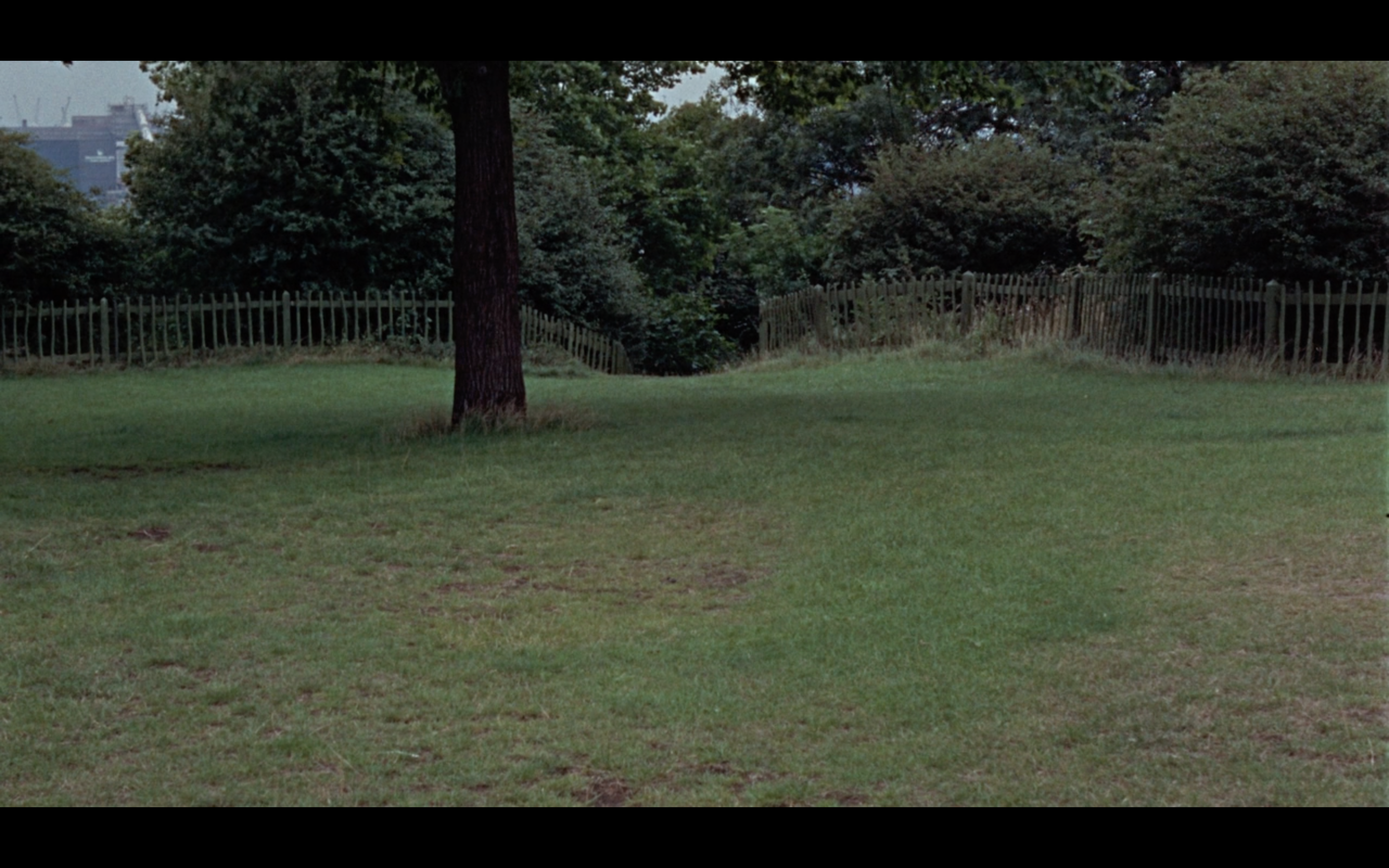
But then comes his walk in the park. What’s engrained in Antonioni’s cinema is the idea that while the character might not be really seeing, the camera sees him, even constitutes as the agency of his regard – his eyes, while sustaining a distance from his psyche. The camera pans, and all of a sudden, a bouquet of flowers appears in the foreground as Hemmings walks away into the depth of field. But no, our post-modern man couldn’t see the nature. The space here is eerily empty, as if a blank canvas, a blank movie screen waiting to be filled, and that’s exactly what happened: a woman and a murder? The woman tracks him down at the studio, the photographer flirted around with her, exchanging a fake reel and a fake telephone number – to no end. The witness of the movie camera thus is no longer on his side. He then resorts back to his materiality, the photographs. Seeing has now became fuzzy, and therefore fiction was born. The act of looking becomes “seeing things.” As we look at things, what we begin to see is the fiction. The more “blew up” the images are, stronger the fiction is. In the fictional murder that emerges from the photographs, the actual murder is that of the looking, which is turned into a constant deciphering of signs and symbols – from one abstraction to another, the constant “blowing up” which resulting an image that can no longer be seen but to be “filled up.” Therefore, at night, by returning to the “scene of the crime,” conspiracy is born. Memory is a strange animal, the power of the film’s final scene was so strong in its invisible tennis game, it’s easy to forget that Hemmings (and us) actually saw a dead body that night. But there he made a mistake by forgetting to take the camera with him. A modern error: without the materiality of the image, the conspiracy of the photographer shall never be confirmed and thus, never the reality.
Three sets of dualities: positive and negative, reality and imaginary, day and night. Blow-Up is a film that attempts to remedy the existential, make-believe nature of cinema: although seeing is no longer believing, yet we must still see, even in its illusions, in order to find our truth in our reality, though it might just turn out to be exactly how we started with, as abstractions. In the age of virtuality, one either only sees what’s “in” the image, or only sees the imaginary. We are no longer Rousseau, who at the end of his life, surrounded himself the world of nature and botany (Les rêveries du promeneur solitaire), where he found peace and a restored curiosity; we are David Hemmings, who only see the invisible tennis among the crowd of youth. The next morning, he returned to the park with his camera, only to find no evidence of his subject, and it’s only fitting that his body finally dissolves into the celluloid. But the trees are still blowing in the wind, and perhaps only in the presence of nature, Antonioni presented his final wish in a chaotic world.

留下评论